Menu
.png)
When employees contribute to AI solutions at work, recognizing their efforts isn’t just polite - it’s smart. Companies that reward AI-related contributions see nearly 6x more financial benefits. Yet, 77% of organizations fail to do this, leading to missed opportunities, reduced morale, and burnout. Traditional rewards like cash bonuses or plaques don’t work for AI innovation, which thrives on collaboration and experimentation.
Instead, here’s how you can reward AI contributions effectively:
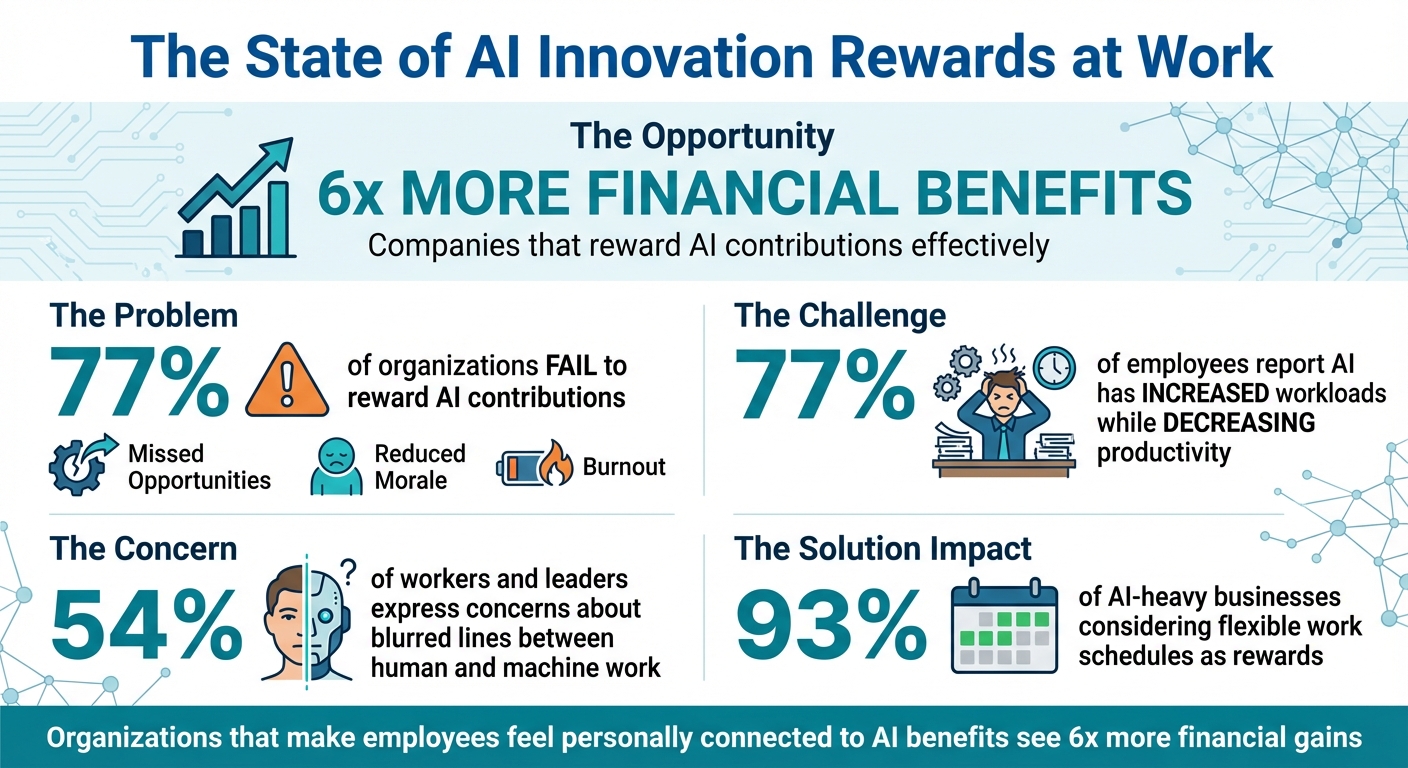
AI Innovation Reward Systems: Key Statistics and Impact
Standard recognition programs - like annual bonuses, generic gift cards, or "Employee of the Month" plaques - were designed for predictable, routine tasks. But AI innovation is anything but predictable. It's dynamic, collaborative, and full of experimentation. Trying to fit this kind of work into outdated reward systems can actually drain motivation, making it clear that a fresh approach is needed.
One of the biggest flaws with traditional rewards is how poorly they align with the realities of AI innovation. Research shows that monetary incentives, like cash bonuses, can actually hurt creativity in AI-related tasks. They reduce innovation to a simple transaction rather than encouraging the kind of imaginative thinking AI work requires.
"The scientific consensus seems to be that monetary rewards don't work for motivating creativity, and there's evidence that they can even hurt performance in creative endeavors, such as innovation." – Jesse Nieminen, Co-founder, Viima
Another issue is how these programs overlook the hidden, yet critical, work involved in AI innovation. Teaching machines, cleaning messy datasets, and handling the complexities that arise after automation often go unnoticed. When 77% of employees report that AI has increased their workloads while also decreasing productivity, it’s clear that a generic gift card or plaque won't recognize their contributions or inspire them to keep pushing forward.
On top of that, AI innovation thrives on teamwork, but traditional rewards tend to focus on individuals. Singling out one person for recognition can actually discourage the collaboration that’s essential for successful AI projects.
Given the gaps in traditional reward systems, it's clear that tailored approaches are better suited to the challenges of AI innovation. Standard programs fail to value the unique blend of human and AI contributions that drive progress. With 54% of workers and leaders expressing concerns about the blurred lines between human and machine work, it’s obvious that old frameworks just don’t cut it anymore.
Custom rewards succeed because they tap into what truly motivates AI innovators: the desire for mastery, a sense of purpose, and the chance to see their ideas come to life. Instead of relying on fixed bonuses or generic rewards, companies can offer meaningful incentives - like giving employees the time and budget to lead the rollout of their AI projects, or providing professional development opportunities, such as attending specialized conferences or leading cross-functional teams.
In the fast-paced world of AI innovation, timing is everything. Waiting for quarterly or yearly reviews often means missing the chance to acknowledge contributions when they matter most. Companies like Shutterstock and Waste Management have shown that personalized, real-time recognition of meaningful contributions can spark even more innovation.
The takeaway is simple: if you want to encourage employees to drive AI innovation, you need to reward them in ways that reflect the unique, collaborative, and unpredictable nature of their work. Generic programs just won’t cut it.
Creating a reward system tailored to AI contributions requires precision. It’s not just about acknowledging outcomes but also about recognizing the processes and teamwork that drive innovation. Traditional reward systems often fall short in the dynamic, collaborative nature of AI work. To build an effective system, start by identifying which contributions deserve recognition and then design rewards that feel meaningful and personalized.
To start, define the types of contributions that merit recognition. In AI, success isn’t just about launching a working model - it’s about the entire journey. Celebrate employees who take initiative, experiment with new ideas, and share their findings openly, even if a project doesn’t hit its targets. This approach reinforces a culture of learning and resilience.
Team efforts that blend human expertise with AI tools also deserve acknowledgment. For example, recognize employees who master new AI skills, use AI to achieve business goals, or mentor colleagues in using these tools. Companies like Booking.com have set a great example with their "GenAI Studio", enabling non-technical staff to design experiments while tracking their impact on customer engagement. Similarly, an automotive company created "Digital Doug", an AI program that preserves the specialized knowledge of a retiring employee to train others.
To measure success, focus on metrics that matter - like adoption rates of new AI solutions, feedback on internal platforms, or measurable improvements in operations. Since AI innovation is rarely a solo effort, prioritize team achievements over individual ones. This approach fosters collaboration and a shared commitment to advancing AI capabilities.
Once you’ve identified the contributions to reward, the next step is crafting rewards that resonate on a personal level.
Generic rewards won’t motivate AI innovators. Instead, consider a tiered system that aligns with individual preferences and contributions:
"Intrinsic rewards can be much more powerful, have much longer lasting effects, and even be more affordable for the organization." – Jesse Nieminen, Co-founder, Viima
Surprise rewards often have a greater impact than predictable ones. Recognition from top executives can amplify this effect, making contributors feel valued at the highest levels. Career-oriented incentives, like leading an AI initiative or attending specialized conferences, can also be highly motivating. With 93% of businesses relying heavily on AI considering a four-day work week, flexible scheduling could be a compelling reward as well.
AI-powered platforms can revolutionize how organizations recognize contributions. These tools monitor performance in real time, identify key achievements, and suggest personalized rewards. By analyzing employee data, they can predict what types of rewards will resonate most and even use sentiment analysis to gauge satisfaction levels.
For example, Artech Digital offers AI-driven solutions that automate recognition processes. Their tools track AI-related milestones, reduce bias through objective data analysis, and ensure rewards are timely and meaningful. When employees feel personally supported by AI, organizations are nearly six times more likely to see significant financial benefits. This makes AI-powered recognition tools a critical piece of any reward strategy.
Timing is everything when it comes to recognizing AI-driven efforts. When employees experiment with AI tools or tackle machine learning challenges, immediate acknowledgment can reinforce their innovative spirit and encourage them to keep pushing boundaries. AI-powered monitoring systems make this possible by tracking performance in real time and instantly highlighting achievements. This kind of instant feedback is crucial in AI work, which often involves trial and error. Recognizing effort - even when projects don’t succeed on the first try - helps maintain motivation and prevents frustration.
Real-time recognition also tackles an often-overlooked issue: the extra effort required to train machines or manage complex AI tasks. Acknowledging this work not only validates employees’ contributions but also helps reduce stress and boost morale. Ryan Duguid, former chief evangelist at Nintex, put it perfectly:
"We don't want workers who self-automate to keep this to themselves. We want to reward their agility and curiosity".
Companies that focus on developing both human and AI capabilities are nearly twice as likely to have employees who feel their work has purpose.
Immediate feedback is powerful, but it becomes even more impactful when combined with peer recognition. Encouraging team members to celebrate one another’s AI-related contributions creates a culture of shared success that goes beyond top-down acknowledgment. Digital platforms that allow employees to publicly recognize their colleagues are especially effective in hybrid or remote work setups. For example, in October 2024, Amazon introduced an AI "coach" that provides real-time feedback based on collective workforce experience. This tool democratizes recognition, ensuring no contribution goes unnoticed.
Organizations can also set up systems where employees share their AI wins - like code snippets, successful prompts, or automated workflows - in accessible repositories. Colleagues can then adopt these ideas and even "like" them, creating a collaborative and encouraging environment.
While peer recognition is essential, the tools supporting it need to be simple and user-friendly. Overly complicated systems can discourage participation. Instead, integrate recognition tools into platforms employees already use daily, such as Slack, Microsoft Teams, or your learning management system. AI-powered chatbots can make the process even smoother, allowing employees to submit recognition quickly without dealing with lengthy forms.
A great example comes from Chevron, which made low-code tools for workflow automation accessible to non-technical staff. By removing barriers, the company encouraged both innovation and recognition. Automation can further enhance this process. For instance, you can implement systems that automatically award badges or points when employees complete specific AI-related tasks, like finishing training modules or sharing knowledge with their team.
In 2023, Waste Management piloted a program where drivers used AI-optimized routes. Those who followed the AI’s suggestions and increased their pickup volume received immediate financial rewards. By embedding recognition into everyday workflows, companies can make it a natural part of their culture.
Once your AI reward program is live, the next step is figuring out if it’s actually working. This is where measurement comes in - and it’s shocking how often it gets overlooked. While 78% of large companies have a documented employee engagement strategy, only half of them bother to measure its success. Even fewer - just 15% - use analytics technology to track recognition programs. Without proper metrics, you’re essentially guessing whether your investment is paying off or if tweaks are needed.
Mike Byam, Managing Partner at Terryberry, puts it plainly:
"All significant HR programs should have some measures of success, and that includes recognition".
Thankfully, AI makes this easier. Modern tools can track participation and productivity in real time, giving you the data you need to fine-tune your approach. Combined with real-time feedback, these insights ensure your reward system evolves alongside your AI initiatives.
Start with performance indicators that connect directly to your business goals. Look at productivity gains, retention rates, and employee engagement levels to see if your rewards are driving the right outcomes. For instance, nearly half of organizations believe that optimizing performance management and reward systems could boost productivity by at least 10%.
Beyond the basics, dig into behavioral metrics. Are employees sharing knowledge more? Completing training modules? Living out company values? AI tools can track these behaviors and reveal which rewards create meaningful change. Skill acquisition is another critical area to monitor. In fact, 54% of organizations now factor skills into performance discussions, and 78% tie them directly to career development.
AI also helps ensure fairness by analyzing performance data objectively and distributing rewards equitably. This builds trust and reduces bias. Additionally, track how quickly employees are recognized for milestones like meeting sales quotas or finishing training. These metrics not only measure your program’s current success but also highlight areas for improvement.
Once you’ve collected the data, it’s time to act on it. AI-powered sentiment analysis can evaluate employee communications to gauge satisfaction and flag potential issues before they escalate. You can also analyze which reward types align best with organizational goals. If certain incentives consistently deliver better results, double down on those.
For smaller companies with limited historical data, synthetic data can be a game-changer. It allows you to train AI models and test different reward strategies, making advanced analytics accessible regardless of your company size. This predictive capability helps you identify what’s likely to work best for your team.
Allan Schweyer, Chief Academic Advisor at the Incentive Research Foundation, highlights the potential:
"Companies investing in these AI-powered methodologies might gradually leverage them as predictive tools to determine optimal reward strategies".
Even with AI, human judgment remains essential. While 37% of organizations are already using AI for performance management, the best programs balance automation with human oversight - especially for decisions involving pay. Training managers to interpret data and effectively use recognition tools is crucial, yet only 20% of managers are currently seen as effective coaches.
| Metric Category | What to Track | Why It Matters |
|---|---|---|
| Engagement | Participation rates, sentiment scores, peer nomination frequency | Shows how well the program is adopted and its impact on morale |
| Performance | Sales quotas, project completion time, productivity percentage | Directly ties rewards to business outcomes |
| Retention | Turnover rates among top performers, average tenure | Indicates if rewards help retain top talent |
| Development | Skill acquisition, training completion, promotion rates | Tracks career growth and long-term capability building |
| Equity | Demographic reward distribution, pay transparency | Ensures fairness and reduces bias in recognition practices |
Organizations that embrace AI as a collaborative tool are nearly 6 times more likely to achieve meaningful financial gains when employees feel personally connected to its benefits. However, a staggering 77% of organizations have yet to implement programs that effectively share the rewards of AI-driven productivity with their teams.
The future of rewarding AI-driven success lies in moving beyond generic incentives. Instead, it’s about creating personalized rewards that value the process as much as the outcomes. Real-world examples show that when companies share the productivity gains of AI with their employees - whether through reduced hours, increased flexibility, or other non-monetary benefits - they foster trust and inspire innovation.
The key to effective reward systems is blending AI-powered insights with human understanding. This approach allows organizations to track engagement, performance, and skill development in a way that feels meaningful.
"As a result of AI transformation, we have started planning for the skills of the future... This will also involve the employee value proposition shifting to skills that are uniquely human - and moving away from skills that machines can master".
To keep pace with this evolution, reward systems should celebrate collaboration, experimentation, and the distinctly human capabilities that make AI initiatives thrive. By combining real-time data insights with thoughtful human oversight, companies can create a sustainable culture of innovation.
The path forward doesn’t require massive leaps. Start small, measure consistently, and refine your approach based on the insights you gather. Organizations that master this balance won’t just adopt AI more effectively - they’ll build workplaces where innovation flourishes and employees feel genuinely valued for their contributions.
Traditional reward systems often miss the mark in supporting AI-focused innovation. Why? They're often one-size-fits-all, slow to evolve, and lack the tailored touch needed to align with the fast-moving, experimental world of AI. These systems simply can't keep up with the need for real-time feedback and customized incentives that drive progress in this field.
When rewards aren't personalized or data-driven, employees may feel their efforts in advancing AI aren't truly valued. This can sap motivation and dampen engagement. To spark fresh ideas and encourage bold experimentation, businesses need reward systems that match the energy and forward-thinking nature of AI innovation.
To truly acknowledge the contributions driven by AI, companies can craft personalized rewards by tapping into data insights and understanding what motivates their employees. Start by measuring the tangible outcomes of AI initiatives - things like cost reductions, new feature rollouts, or operational efficiency gains. These metrics can then be directly tied to specific rewards.
AI-powered analytics can help pinpoint what drives each employee, whether that’s cash bonuses, professional development opportunities, public recognition, or even equity options. By offering a flexible range of rewards, you ensure employees feel appreciated in ways that resonate with them. For instance, you could link a $2,000 bonus to achieving a 10% reduction in costs.
The timing and personalization of rewards are just as important as the rewards themselves. Automating the process with tailored messages that celebrate specific achievements not only saves time but also reinforces positive behavior. Regularly evaluating the effectiveness of these rewards helps ensure they stay meaningful and aligned with your organization's objectives.
Artech Digital offers tools to help your business track contributions, recommend personalized rewards, and seamlessly integrate these systems into your HR processes.
AI tools are reshaping how companies recognize and celebrate employee achievements by making the process faster, smarter, and more meaningful. With the help of machine learning, these tools can analyze performance data - like hitting project milestones, achieving sales targets, or demonstrating company values - and instantly highlight standout contributions. This eliminates the delays that often come with manual reviews, ensuring great work gets recognized right when it happens.
What’s more, AI takes recognition a step further with personalized rewards. By factoring in an employee’s preferences, career aspirations, and past recognition, these tools can suggest rewards that truly resonate - whether it’s a tailored bonus, professional development opportunities, or something else that feels personal and impactful. Plus, because AI relies on objective data, it helps reduce unconscious bias, creating a recognition system that’s not only fair but also inclusive. This approach empowers businesses to build systems that drive motivation, encourage innovation, and tie rewards directly to their strategic goals.
For companies looking to adopt AI-powered recognition, Artech Digital provides seamless integration services. They help turn raw performance data into timely and meaningful celebrations of employee success.

.png)