
Menu

AI-powered voice search is reshaping how people shop by simplifying product discovery and boosting sales. For a mid-sized fashion retailer struggling with outdated search tools, integrating a voice search solution led to a 35% increase in search conversion rates and a 24% rise in revenue from search. Here's how it worked:
This case highlights how AI voice search can resolve search inefficiencies, improve mobile shopping, and help businesses stay competitive in a fast-evolving market.
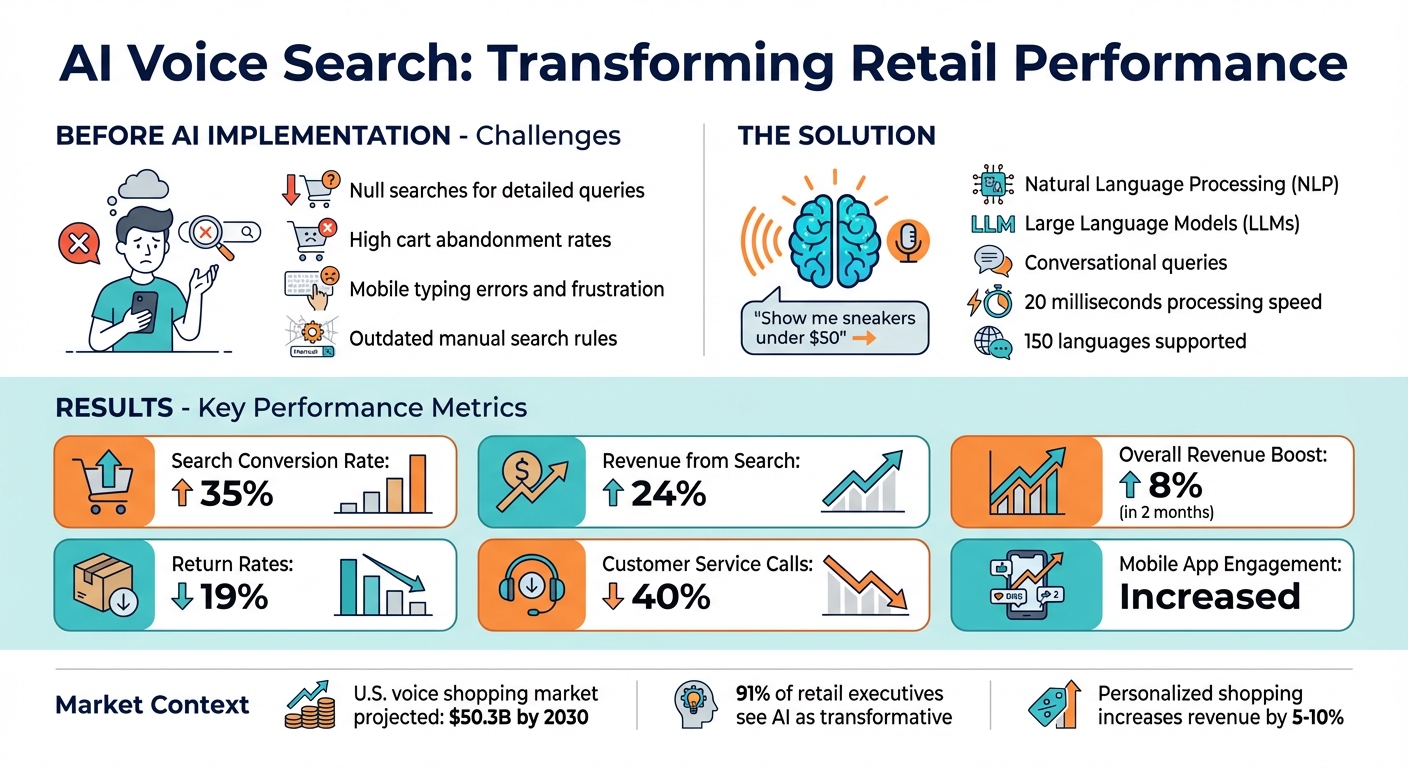
AI Voice Search Impact: Key Performance Metrics for Retail Success
The retailer faced more than just a clunky search bar. Their entire product discovery system was outdated, falling short of modern customer expectations - and it was starting to hurt their bottom line.
Managing their product catalog was a nightmare. Their system relied on manual search rules, meaning the merchandising team had to submit IT tickets every time they wanted to tweak how products appeared in search results. This process was slow and inefficient, often leading to outdated, irrelevant, or even broken search results.
To make matters worse, the legacy system frequently returned "null searches" for detailed queries like "flowy maxi dress for beach vacation", even when matching items were in stock. The static filtering system didn’t help either - it showed the same generic filters across all product categories, making it hard for customers to refine their search. On top of that, inventory mismatches created a frustrating experience where customers added items to their carts only to discover they were unavailable at checkout.
These issues hit mobile sales particularly hard, highlighting an urgent need for improvement.
The mobile shopping experience was another pain point. Typing on small screens often led to autocorrect errors and typos, frustrating users. Text-based search also required customers to translate their visual ideas into specific keywords - a process that felt unnatural and often caused them to leave the app quickly. Since mobile traffic made up the bulk of user sessions, these issues translated into a significant loss of potential revenue, with many shoppers abandoning their journey before reaching the checkout.
While internal inefficiencies were a problem, the retailer also faced mounting pressure from competitors who were pulling ahead with cutting-edge technology.
While this retailer struggled with outdated search tools, competitors were already adopting advanced, AI-driven solutions. According to industry data, 91% of retail executives saw AI as a transformative technology for the future. Early adopters were already reaping the rewards. For example, Caleres, the parent company of Famous Footwear and Dr. Scholl's, swapped manual search rules for machine learning models to manage 600,000 SKUs. The result? A 21% year-over-year revenue increase and a 25% boost in search conversion rates.
The competitive landscape was shifting fast. Retailers offering seamless, voice-enabled search experiences were setting new standards for customer expectations. Every time a shopper enjoyed a smooth search on a competitor’s app, their patience for clunky, text-based systems dwindled. Without a major upgrade, this retailer risked losing even more market share.

Artech Digital introduced an AI-driven voice search feature to enhance the retailer's mobile app experience. By incorporating natural language processing (NLP), large language models (LLMs), and custom machine learning, they revolutionized how customers searched for products. Instead of typing "running shoes size 9", users could simply say, "Show me sneakers under $50", and the system would interpret their intent, delivering accurate results instantly. This marked a shift toward a more advanced technical framework.
At the heart of this solution was a semantic search system powered by vector embeddings, which focused on understanding the meaning behind queries rather than just matching keywords. For instance, searching "coffee machine for bachelor" would return compact, single-serve options instead of large, industrial brewers. This level of contextual understanding was achieved by fine-tuning LLMs on the retailer's product catalog and customer-specific language patterns, ensuring the AI worked with actual inventory data rather than relying on assumptions or guesses.
The voice recognition engine processed spoken queries in under 20 milliseconds, a speed made possible through neural hashing techniques. These techniques allowed near real-time query handling without compromising accuracy. Impressively, the system supported up to 150 languages, making it accessible to a global audience.
The NLP engine played a key role by converting spoken instructions into actionable commands. It analyzed speech patterns, accents, and dialects, while the LLMs extracted intent. For example, if a user requested "sneakers under $50", the system could determine whether they meant athletic shoes, casual footwear, or kids' options, factoring in their browsing history. This approach eliminated the frustration of irrelevant or null search results that plagued earlier systems.
Beyond speed and accuracy, the system offered highly personalized search experiences. It didn’t just understand what users said - it remembered who they were. Custom machine learning models evaluated each customer's purchase history, browsing habits, and preferences to tailor search results for a truly individualized experience. For example, if a shopper frequently bought size 8 women's shoes, those options would appear first when they searched for "sandals."
This personalization was powered by AI-driven reinforcement learning, which analyzed user actions in real time to dynamically adjust search rankings. Additionally, probabilistic binomial models helped provide accurate size and fit recommendations, reducing returns by suggesting the best options based on past purchases and body measurements. Research shows that personalized shopping can increase revenue by 5–10%, and 56% of consumers are more likely to become repeat customers after receiving tailored service.
Artech Digital seamlessly integrated the voice search feature into the retailer's existing mobile app using an API-first architecture. This setup worked smoothly with the retailer’s Shopify backend. The integration enabled voice-activated features such as product searches, adding items to the cart, and real-time inventory checks - all hands-free. For instance, a user could say, "Add these black boots to my cart", and the system would update the cart and provide visual confirmation.
The implementation emphasized low latency and natural-sounding interactions, ensuring the experience felt conversational rather than robotic. Features like "barge-in" allowed customers to interrupt the AI mid-response to refine their search, mimicking the flow of a conversation with a human sales associate. Voice biometrics ensured secure, hands-free payments while maintaining PCI-DSS compliance. The integration connected the voice interface with the retailer's product catalog, inventory system, CRM, and payment gateway through flexible middleware, ensuring compatibility with their existing infrastructure.
The rollout was carried out in four well-defined phases. Artech Digital began with a discovery phase, collaborating closely with the retailer's team to outline clear business objectives, such as cutting down cart abandonment rates and improving product discovery. Next, they selected a scalable, cloud-based technology stack to ensure the solution could grow with the retailer's needs. The third phase focused on designing a voice user experience (VUX) that felt natural and intuitive for customers. Finally, the team worked on data ingestion and ETL processes, which involved standardizing the product catalog data to make it compatible with the AI system.
Extensive testing was conducted to ensure the voice recognition performed reliably under real-world conditions while complying with GDPR regulations. A middleware layer was implemented to connect existing legacy systems with the new AI infrastructure, allowing for a smooth transition without disrupting day-to-day operations.
These carefully executed steps led to clear and measurable business improvements.
The results were impressive. The integration led to a 19% drop in return rates and reduced customer service calls by 40%, thanks to the voice assistant effectively handling routine inquiries. These numbers highlight how AI-powered voice search can streamline operations and significantly improve the customer experience.
The solution brought valuable insights and opportunities for improvement, enhancing the customer experience and laying the groundwork for scaling operations across the enterprise.
The success of this project hinged on quick responses and the ability to understand user intent accurately. The AI system could handle natural language queries like "Find me a black jacket under $100" without relying on exact keyword matches, thanks to its advanced integration of natural language processing (NLP) and large language models (LLMs). It also excelled in context awareness, remembering previous interactions during the same session and enabling smooth, multi-turn conversations for refining searches.
A key focus on low latency ensured the voice assistant responded swiftly, keeping users engaged and reducing the likelihood of search abandonment. The system also leveraged real-time behavioral data and purchase history to deliver personalized product recommendations. This approach not only boosted engagement but also increased the average order value.
Real-world environments introduced background noise, which was mitigated through the integration of automatic speech recognition (ASR) with noise reduction techniques. This ensured the system performed reliably in various settings. Another critical challenge was preventing AI hallucinations - the system was designed to deliver accurate responses based on the actual product catalog and inventory data, avoiding unreliable or fabricated information.
Integrating the AI with legacy systems required thoughtful planning. Flexible APIs and middleware were employed to connect the new AI infrastructure with existing eCommerce platforms, order management systems, and CRM tools without necessitating a complete overhaul. To address user trust concerns, voice biometrics were implemented for secure authentication, alongside transparent data privacy policies that adhered to GDPR standards. These measures solidified the seamless retail experience envisioned from the start.
Scaling to enterprise-level operations demands robust automation, particularly for managing extensive catalogs. For instance, in early 2024, a major online fashion retailer collaborated with Wursta to implement automated ETL processes that integrated seamlessly with their Google Merchant Center catalog. This upgrade led to an 8% revenue increase within just two months. The system was then extended to a sister brand in under a week.
For companies operating multiple sites, centralized control over merchandising becomes vital. One enterprise reported a 21% year-over-year revenue increase and a 25% improvement in search conversion rates after transitioning multiple sites to an AI-powered platform. Artech Digital's Enterprise AI Pro package supports such scaling needs, offering tools like multi-site management, automated catalog enrichment using Vision AI, and LLM processing in up to 150 languages for global reach.
To sustain growth, businesses can utilize behavioral data from platforms like Google Analytics to fine-tune AI models and align them with specific performance metrics.
By tackling challenges like poor search experiences, low mobile conversions, and increasing competition, this project delivered measurable business benefits. The integration of AI-powered voice search revolutionized how customers interacted with the app, making it easier to connect users with products. Instead of relying on tedious typing or navigating complex menus, shoppers could use natural language queries. This approach not only addressed the limitations of mobile screen space but also introduced intent-based discovery that aligned with what customers were genuinely looking for. The shift from basic keyword matching to conversational search paved the way for smoother purchasing journeys, reducing cart abandonment and increasing engagement.
The results speak volumes: a 35% rise in search conversion rates, a 24% increase in revenue from search, and an 8% overall revenue boost within just two months. Beyond the numbers, this solution enhanced accessibility for users with visual or motor impairments and positioned the client to thrive in the growing U.S. voice shopping market, which is projected to hit $50.3 billion by 2030. These achievements underscore the significant impact of this transformation.
At the heart of this success was Artech Digital's tailored AI solution, designed specifically for the client’s catalog and user behavior. Their approach seamlessly integrated advanced natural language processing with existing eCommerce systems, order management platforms, and CRM tools. This allowed the AI voice assistant to deliver personalized recommendations based on purchase history, building on prior successes in customized search experiences.
This case study highlights how AI voice search can redefine the way customers discover and buy products while delivering tangible business results. It also demonstrates that successful AI implementation goes beyond simply using pre-built technology - it requires ongoing model training and refinement. With Artech Digital’s Enterprise AI Pro package, businesses gain access to features like multi-site management, automated catalog updates, and robust multilingual support, enabling global deployment of voice search capabilities.
AI voice search is changing the way people shop, making it easier and more natural. Instead of typing out specific keywords, users can simply speak as they normally would. The technology picks up on context, synonyms, and casual language, so there’s no need to worry about misspellings or figuring out the exact terms. Plus, it’s hands-free, which is perfect for multitasking - like shopping while cooking dinner or driving.
But it’s not just about convenience. Voice search also delivers results faster and tailors them to the user. For instance, if someone says, "Find red sneakers under $100", the system quickly pulls up the most relevant options, cutting down on time and effort. Retailers who embrace voice-first technology are seeing higher conversion rates and happier customers because it meets the growing demand for fast, personalized, and hassle-free shopping.
Artech Digital helps brands stay ahead by integrating AI voice search into their retail apps. This allows businesses to offer an advanced shopping experience that focuses on speed, precision, and ease for their users.
Artech Digital improves voice search by using custom AI agents that combine speech-to-text transcription, natural language understanding, and dialogue management. These agents rely on fine-tuned large language models (LLMs), specifically optimized for the retail sector. By training on focused datasets and applying methods like caching and prompt engineering, they enhance both the speed and accuracy of voice search responses.
To make the experience more personalized, Artech builds custom machine learning models that evaluate user behavior, purchase history, and contextual factors. These models provide tailored recommendations and prioritize search results based on individual preferences, ensuring shoppers receive relevant and precise answers. This combination of technologies offers a smooth and highly effective voice search solution for retail applications.
Integrating AI voice search into retail apps brings major advantages for both businesses and their customers. It allows shoppers to enjoy a hands-free, quicker, and tailored shopping experience, making it easier to find products without hassle.
For retailers, this added convenience translates into better customer engagement, higher conversion rates, and boosted sales. By streamlining product discovery and simplifying the shopping journey, AI voice search enhances the overall experience, making it both intuitive and enjoyable.
.png)

.png)
