
Menu
Generative AI is transforming social media marketing by enabling marketers to create tailored posts, images, videos, and campaign strategies in minutes. Unlike predictive AI, generative AI produces content from scratch, helping brands maintain consistent posting schedules, personalize campaigns, and optimize performance. Here's what you need to know:
Generative AI not only reduces manual effort but also drives better results through automation and data-driven insights, making it a key tool for modern marketing strategies.
Generative AI plays a key role in every phase of a social media campaign - whether it's drafting posts, fine-tuning ads, or managing interactions. By 2025, leveraging AI to scale social content has become a standard practice for marketing teams. This technology creates both organic and paid content, producing captions, images, video scripts, and even audio voiceovers tailored for specific platforms. These abilities help brands align their content with campaign goals while fostering stronger community connections.
Generative AI can churn out a variety of content, including captions, ad copy, hooks, calls-to-action, scripts, and short-form video ideas designed for platforms like TikTok, Instagram Reels, YouTube Shorts, and LinkedIn. It can produce multiple versions with variations in tone, style, and length, making it ideal for A/B and multivariate testing in paid campaigns. Marketers also rely on AI to transform long-form content into bite-sized social media snippets. While AI handles the initial drafts, human editors step in to polish the content, ensuring it aligns with the brand's voice.
Interestingly, a 2025 study revealed that when human editors guide and refine AI-generated content, consumers rate it as just as realistic and high-quality as content created by professional marketers.
This ability to create diverse, tailored content ensures that AI can meet the specific needs of different campaigns.
Generative AI adjusts its output to align with a campaign's objectives, whether it’s raising brand awareness, driving engagement, generating leads, boosting e-commerce sales, or remarketing. For brand awareness, AI can craft compelling stories, educational carousels, and visually striking posts designed to maximize shares and reach. For lead generation, it creates lead magnets, landing page copy, and ad variations targeted to specific U.S. audience segments. E-commerce campaigns benefit from dynamic product visuals, detailed descriptions, and timely remarketing messages triggered by user actions.
In the realm of remarketing, AI can develop personalized message flows that guide users from initial awareness to taking action. It can also create multiple ad variations with unique headlines, images, and offers to better match user behavior. For example, Spotify boosted user engagement by 40% using AI-driven personalization, while Burberry’s "Digital Design Studio" cut design production time in half with AI-powered tools. Additionally, Buffer’s 2024 data shows that 42% of social media managers use AI for content creation, and 61% of marketers depend on it for personalized content.
Some advanced teams are even training generative AI models on their brand’s historical campaigns, style guides, and guidelines to maintain consistency while scaling up production.
Generative AI doesn’t stop at content creation - it also enhances community engagement by automating interactions. Custom AI agents and chatbots are increasingly used across social media direct messages, comments, and messaging apps to handle FAQs, recommend products, qualify leads, and escalate issues when needed. These tools improve response times and ensure 24/7 engagement that stays true to the brand’s voice. Features like sentiment detection, automated replies, toxic comment filtering, and spam moderation help maintain a positive community experience.
For instance, tools like CommentGuard effectively filter spam while preserving a brand’s tone, and real-time optimization tools help brands stay relevant by reacting to trending topics. Coca-Cola, for example, uses AI-driven personalization to deliver ads that resonate with customers, boosting engagement. Many U.S. companies also deploy chatbots on platforms like Facebook Messenger, Instagram DMs, WhatsApp, and website chats to manage tasks such as order tracking and troubleshooting. More complex issues are routed to human agents when necessary.
To keep automated interactions consistent and safe, brands train custom AI agents on their tone, policies, and compliance requirements, including FTC guidelines for endorsements. AI tools can also analyze real-time sentiment, flag potential crises early, and suggest response templates that social managers can customize for special occasions or events.
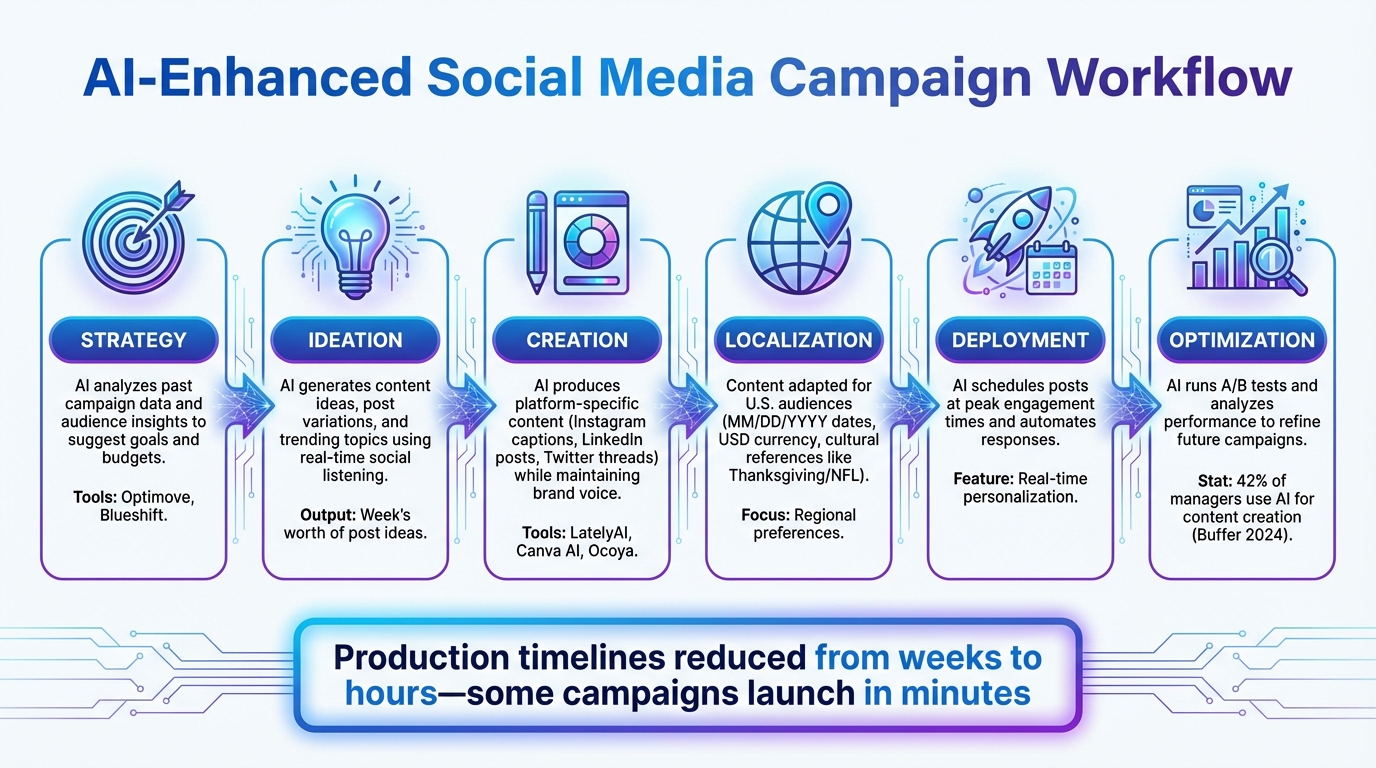
6-Stage AI-Enhanced Social Media Campaign Workflow
Incorporating generative AI into your social media strategy can transform how campaigns are planned and executed. The process typically involves six stages: strategy, ideation, creation, localization, deployment, and optimization. At the strategy stage, AI tools analyze past campaign data and audience insights to suggest goals and budgets. During ideation, AI-powered tools generate content ideas, post variations, and trending topics by leveraging real-time social listening. In the creation phase, generative AI produces platform-specific content - like Instagram captions, LinkedIn posts, or Twitter threads - while staying true to your brand's voice. When it’s time for deployment, AI schedules posts at peak engagement times and can even automate responses. Lastly, the optimization phase uses AI for A/B testing and performance analysis, helping refine future campaigns for better results.
These stages combine AI-driven efficiency with human oversight, simplifying workflows and improving campaign execution. Let’s break down how these stages work in a structured, step-by-step approach.
The first step in this workflow is strategy. AI tools like Optimove and Blueshift analyze market data and segment audiences based on behavior, demographics, and engagement history. This helps marketers identify micro-segments and tailor campaigns accordingly. Next comes ideation, where AI generates a week's worth of post ideas based on industry prompts. Many social media professionals have found that AI tools create high-quality strategies that align with brand needs and solve business challenges through detailed prompts.
In the creation phase, AI tools like LatelyAI convert long-form content into short, engaging social media posts. Canva's AI features can create multiple visual variations, while platforms like Ocoya assist with scheduling and caption generation across multiple channels. Localization ensures content resonates with U.S. audiences by adapting formats like MM/DD/YYYY for dates, using dollars ($) for currency, and incorporating cultural references like Thanksgiving or NFL promotions. During deployment, AI automates post scheduling and personalizes content in real time based on user data. Finally, the optimization phase uses AI to run A/B tests and analyze sentiment, refining future campaigns. Tools like Buffer report that 42% of managers already use AI for content creation and scheduling, enabling faster execution of high-volume campaigns. Some teams have reduced production timelines from weeks to just hours, with campaigns sometimes launching in minutes.
Generative AI is particularly effective at personalizing content to meet U.S. preferences. It analyzes user data to create micro-segments and tailors content to regional standards, such as MM/DD/YYYY date formats, U.S. dollar currency, and imperial units. For example, when prompting AI, you can specify, "Use USD, MM/DD/YYYY, and American English slang" to ensure proper localization. AI tools can also craft content that aligns with regional holidays like Black Friday or seasonal events tied to U.S. sports. Spotify demonstrated the power of AI-driven personalization with its Discover Weekly feature, boosting user engagement by 40% by tailoring recommendations based on individual listening habits.
By training on U.S.-specific data, AI minimizes errors in localization and ensures relevance. In 2024, 96% of marketers reported increased sales from AI-driven personalized experiences. With this level of customization, AI solutions not only enhance engagement but also streamline the overall campaign process.
Custom AI solutions take automation a step further by integrating every stage of the workflow, from ideation to optimization. Fine-tuned large language models can generate brand-specific content, manage workflows, and enable real-time personalization. For instance, Artech Digital specializes in creating AI-powered tools like web apps, advanced chatbots, and machine learning models tailored to specific needs. One of their innovations, the AI Listing Agent and Chatbot for Home Show AI, automatically generates product listings from images or videos, cutting content creation time in half for marketplace users.
Artech Digital's approach includes mapping out goals, data, and workflows, rapidly building a minimum viable product (MVP) through weekly demos, and integrating solutions with platforms like Azure or AWS for seamless deployment. Tools like their Lead Gen AI tracking app help B2B sales teams identify and act on real-time engagement signals, making prospecting smarter and more efficient. In community management, solutions like Dolman AI Chat automate case evaluations and answer FAQs, saving over 1,000 support hours per month. These custom solutions can cut production time by up to 50%, all while maintaining brand consistency through model fine-tuning on proprietary data.
Once your AI workflow is up and running, the next step is to supercharge your campaign's performance. Generative AI plays a key role here by crafting test variants at scale, analyzing critical metrics, and tailoring content to specific audiences. This technology allows marketers to churn out dozens of variations in just hours, enabling AI to identify the most effective options in real time. For example, Hootsuite's 2025 research revealed that 43% of marketers view AI as a crucial part of their social media strategy. With AI handling testing, analysis, and optimization, teams can shift their focus to strategy. This creates a powerful opportunity to refine every aspect of your campaigns.
Generative AI takes A/B testing to the next level by quickly generating multiple variations. Tools like Canva's AI, Copy.ai, LatelyAI, and Ocoya can produce content variations, repurpose materials, and even schedule posts. This enables marketers to experiment with different tones, formats, and calls-to-action in a fraction of the time it would take manually. Instead of spending days crafting five headline options, AI can deliver up to 50 ad variations in a single day. This allows for testing a range of approaches - whether it's a professional versus playful tone, Reels versus standard feed posts, or "Shop now" versus "Learn more" calls-to-action - without exhausting your creative team. AI also helps combat ad fatigue by monitoring engagement trends and suggesting updates to creatives before performance dips. Once the top-performing creatives are identified, AI takes over, optimizing budgets and key performance metrics for maximum impact.
AI excels at analyzing metrics like click-through rate (CTR), cost-per-click (CPC), and return on investment (ROI) to make real-time budget adjustments. By reallocating funds to the best-performing audiences and creatives, AI ensures every dollar works harder. For instance, if Instagram Reels are delivering lower CPCs and higher conversions compared to feed posts, AI can instantly shift more budget toward Reels. According to Buffer's 2024 report, 42% of managers are already leveraging AI for content creation and scheduling. This streamlines campaign launches and drives better engagement. AI-powered dashboards further enhance decision-making by running "what-if" scenarios, predicting how budget shifts could influence cost per acquisition. This dynamic approach keeps campaigns running efficiently and effectively.
After optimizing budgets, AI takes campaign performance a step further by personalizing content for highly specific audience segments. Generative AI enables hyper-targeted campaigns by breaking down broad demographics into smaller micro-segments based on factors like behavior, demographics, and real-time interactions. For example, instead of targeting "U.S. women aged 25–34", AI refines this group into smaller segments with sharper definitions, such as recent purchase behavior or social media activity. Tools like Optimove help manage these AI-driven segments while ensuring brand guidelines stay intact. Coca-Cola, for instance, used AI platforms to create personalized ads tailored to customer data, achieving higher engagement rates and saving significant time. Similarly, Spotify's AI-driven recommendations boosted user engagement by 40% by personalizing content based on mood and context. By tailoring elements like captions, visuals, and offers to micro-segments - think Black Friday deals for U.S. shoppers or Memorial Day references - AI ensures every impression feels relevant, driving stronger conversion rates.
Navigating the world of generative AI in social media marketing requires a careful balance of ethical responsibility and technical precision.
In the United States, brands are required to follow Federal Trade Commission (FTC) guidelines, which mandate transparency when AI is involved in content creation. Additionally, regulations like the California Consumer Privacy Act (CCPA) emphasize the importance of collecting only the data that is strictly necessary. Respecting intellectual property rights and addressing potential biases in AI outputs are also critical.
To uphold these standards, brands can take practical steps like publishing a clear AI usage policy within their social media guidelines, maintaining a detailed data map for targeted campaigns, and requiring human oversight for content that carries higher risks. For sensitive topics - such as race, religion, or disability - it's crucial to focus on behavioral data rather than relying on protected characteristics. These measures help ensure ethical AI use while maintaining compliance with legal and cultural expectations.
The way generative AI is integrated into social media workflows often depends on the size of the team and the complexity of compliance needs. For smaller teams, built-in AI tools like auto-generated captions or suggested replies can provide quick and simple solutions. Meanwhile, APIs from general-purpose language models allow for generating multiple content variations, with human oversight to ensure alignment with the brand’s voice.
Larger organizations often benefit from fine-tuned AI models that are trained on brand-specific data. These models help maintain a consistent tone and reduce the risk of off-brand messaging. For even more complex operations, custom AI agents can automate multi-step processes while incorporating human approval checkpoints at critical stages. Companies like Artech Digital specialize in creating these fine-tuned models and custom agents, integrating them seamlessly into existing social media platforms through APIs. This approach ensures scalability without compromising on compliance or brand integrity.
Generative AI offers clear advantages, such as increased efficiency and the ability to deliver highly personalized experiences. In fact, in 2024, 96% of marketers reported a boost in sales due to AI-driven personalization. However, these benefits come with risks. AI-generated content can sometimes include inaccuracies (referred to as "hallucinations"), drift away from the brand’s voice, or lead to automated responses that miss the mark during sensitive situations.
To address these risks, brands can implement several mitigation strategies:
The table below highlights the trade-offs and mitigation strategies involved:
| Risk | Benefit | Mitigation Strategy |
|---|---|---|
| Misinformation/hallucinations | Efficiency & scale in content creation | Human review and fine-tuned proprietary models |
| Data privacy breaches (CCPA) | Micro-segment personalization | In-house tools and consent-based data use |
| IP infringement | Rapid A/B testing | Brand-specific training data |
| Bias in outputs | Strategic flexibility | Diverse training data and regular bias audits |
For a mid-sized U.S. company, a secure and efficient AI architecture would typically include a robust data layer with role-based access controls, an AI services layer hosted in a compliant cloud environment, and connectors that integrate with social platforms via their official APIs. A governance layer is also essential, providing logging and alerting mechanisms to track incidents. Additional security measures, such as OAuth-based connections, secret management for API keys, and maintaining detailed audit trails, ensure that AI-driven systems remain secure while staying agile enough to adapt to changing needs.
Generative AI is reshaping the landscape of social media marketing in the U.S., evolving from an experimental tool to an essential asset for brands striving to stay competitive in 2025 and beyond.
Generative AI offers clear, measurable advantages for social media marketing. Brands can now produce tailored content within minutes and scale campaigns to create thousands of targeted variations across platforms like Instagram, LinkedIn, and Twitter. This enables extensive A/B testing and hyper-personalized content that deeply connects with audiences. For example, Buffer's 2024 report highlights that 42% of social media managers use AI for content creation, with 69% viewing it as a technology that creates job opportunities rather than eliminating them. Burberry’s use of a multimodal AI studio in 2024 cut advertising production time by half while maintaining brand consistency.
The future of social media marketing lies in the collaboration between human creativity and AI efficiency. AI excels at handling repetitive tasks at scale, while humans provide the strategic thinking and creative spark that drive impactful campaigns. By fine-tuning AI tools with brand-specific data, businesses can ensure a consistent tone and avoid off-brand messaging. For U.S. companies, this could mean starting with tools like ChatGPT to generate weekly post ideas and gradually adopting advanced solutions for content repurposing, micro-targeted personalization, and real-time performance optimization.

Artech Digital specializes in turning generative AI into practical, competitive solutions for businesses. Their services include:
These systems integrate seamlessly with your existing social media platforms and tools, ensuring a smooth transition.
Artech Digital delivers AI solutions quickly, typically within 4–8 weeks, using a rapid prototyping approach paired with regular demos to keep your goals in focus. They handle all the technical aspects - architecture, API integration, compliance, and ongoing optimization - so you can concentrate on strategy and creativity. With over 120 verified 5-star reviews and a 96%+ job success rate, Artech Digital has a proven track record of delivering AI solutions on time and within budget. Whether you need tools for platform-specific content creation, automated customer interactions, or data-driven insights to optimize budgets, Artech Digital’s expertise can position your business to fully embrace the potential of generative AI in social media marketing. Start leveraging AI today to secure your brand’s future in the ever-evolving digital landscape.
Generative AI is reshaping social media marketing by crafting content that feels personal and relevant to each user. Whether it’s customized messages, images, or videos, this technology taps into user preferences and behaviors to create content that truly connects with audiences. The result? Higher engagement and better conversion rates.
Beyond personalization, generative AI uses data analysis to predict what users might be interested in and pinpoints the best times to post. This ensures campaigns hit the mark with both timing and relevance. For businesses aiming to scale these efforts, Artech Digital specializes in integrating AI tools to simplify and enhance personalized marketing strategies.
When using AI in social media marketing, being upfront about its role is key. Make it clear when content is AI-generated to maintain trust and avoid misleading your audience. At the same time, protecting user privacy should be a top priority, particularly when dealing with personal data. Always ensure compliance with regulations like GDPR to safeguard user information.
Another critical aspect is addressing bias in AI systems. Take steps to ensure your AI tools don’t perpetuate discrimination, spread misinformation, or reinforce harmful stereotypes. Using AI responsibly also means steering clear of manipulative practices. By focusing on ethical usage, you can build trust and foster meaningful connections with your audience.
Generative AI is transforming social media marketing by diving into massive datasets to pinpoint trends and uncover which types of content perform best. It takes care of time-consuming tasks like ad targeting and scheduling, ensuring your campaigns connect with the right audience at just the right moment.
Beyond automation, AI steps up the personalization game. It customizes messages and recommendations, delivering a more engaging and tailored experience for users. On top of that, it offers real-time insights, empowering you to make quick adjustments that boost performance and help you get the most out of your marketing budget.
.png)

.png)
