
Menu

AI is reshaping how businesses make decisions by processing vast amounts of data, identifying patterns, and delivering actionable insights. Here's the core idea: AI doesn't replace human judgment - it enhances it. Companies using AI report faster, more accurate decisions, reduced costs, and improved efficiency. For example:
To implement AI effectively, businesses need to:
Companies like Artech Digital specialize in custom AI solutions, helping organizations integrate AI into their workflows. With a phased, metrics-driven approach, businesses can turn AI into a powerful tool for better decisions and long-term success.
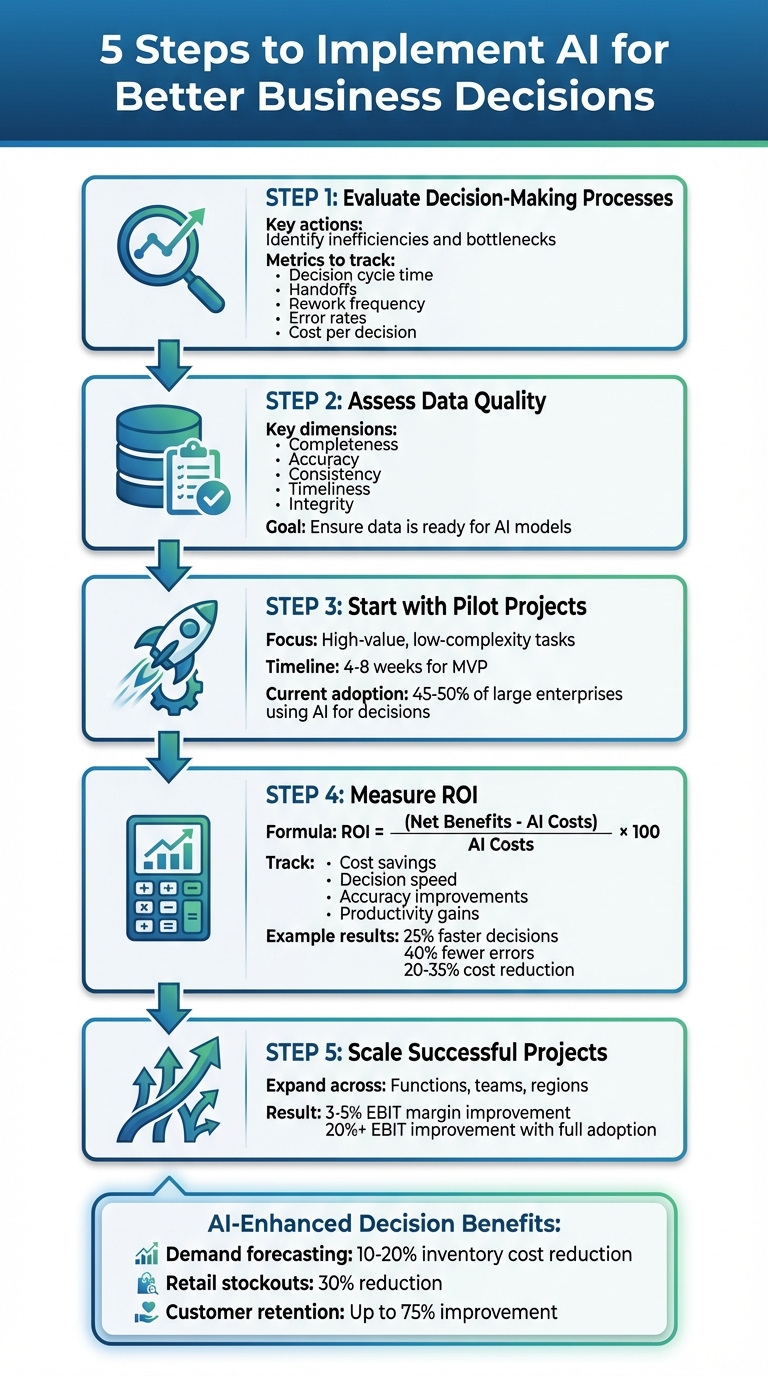
5-Step Process for Implementing AI in Business Decision-Making
Taking a closer look at how decisions are currently made is crucial. Without this step, introducing AI could end up automating inefficiencies, magnifying errors, or misaligning with your broader goals. A thorough evaluation helps identify which decisions truly matter, how they’re executed, and what data drives them. This ensures AI solutions tackle real bottlenecks instead of just making minor, "nice-to-have" adjustments.
Start by selecting two or three pivotal decisions - like pricing strategies, inventory management, or credit approvals. Map out each workflow in detail: who initiates the process, what inputs are required, which tools are used, and who gives the final approval. This exercise often reveals where delays, rework, or manual handoffs slow things down.
To zero in on inefficiencies, track key metrics like decision cycle time, handoffs, rework frequency, error rates, and the cost per decision. For example, a retailer might discover that relying on spreadsheets for multi-step inventory approvals leads to delays and stock shortages. Comparing these metrics across teams or regions can uncover outliers and pinpoint areas where AI-powered tools - like automated forecasting or workflow optimization - could make a meaningful difference.
Use a combination of methods to gather this data:
AI excels in tackling repetitive, data-intensive, and time-sensitive tasks, such as demand forecasting, lead scoring, fraud detection, and streamlining approval processes.
AI models rely heavily on historical data, so poor data quality - whether incomplete, inconsistent, or biased - can lead to unreliable outcomes. Evaluate your data using these core dimensions:
Any weakness in these areas can hurt AI performance, increase error rates, and even create compliance or reputational risks.
Identify where your critical decision-making data lives - whether in CRMs, ERPs, data warehouses, or spreadsheets - and assess how easily it can be accessed. Can it be retrieved programmatically through APIs, data pipelines, or exports?. Look for unified identifiers across systems (like consistent customer IDs), a central data platform, clear documentation, and role-based access controls to ensure secure and efficient data access. If key data is locked in legacy systems, isolated in local files, or only accessible via manual reports, you’ll need to address these gaps with improved data engineering and governance before AI can deliver meaningful results.
To wrap up, compile a "decision improvement backlog." For each key decision, document current metrics, pain points, data sources, and desired improvements. This organized list becomes your starting point for piloting AI projects, choosing the right tools, and, if needed, collaborating with experts like Artech Digital to build custom AI solutions. With this groundwork, you’ll be ready to shape a focused AI strategy for the next phase.
After mapping your decision-making processes and evaluating your data, the next step is to develop a clear AI strategy that ties technology investments to measurable business results. Your AI initiatives should align with key goals like cutting costs, speeding up decisions, or driving revenue growth. Without this connection, AI projects can end up as isolated experiments that fail to deliver meaningful value or secure long-term support.
A strong AI strategy is built on four key elements: data, talent, technology, and governance. For instance, even the most advanced AI tools won't be effective if your team can't interpret their outputs or if you lack governance policies to manage risks. Research from McKinsey reveals that companies that integrate AI into their core operations can improve EBIT margins by 3–5 percentage points in some industries. Achieving this level of impact requires a coordinated, enterprise-wide approach - not just scattered, one-off projects.
Focus on identifying high-value use cases like demand forecasting, pricing optimization, risk assessment, or customer churn prediction. These applications can enhance decision-making speed, accuracy, and outcomes. By evaluating each use case based on its business impact and feasibility, you can create a phased roadmap. Start with high-value, low-complexity projects to build momentum and demonstrate early ROI, making it easier to gain support for more ambitious initiatives.
Every AI project needs well-defined, measurable goals that directly connect to business value. For example, aim to reduce order-fulfillment time by 20% within a year or improve forecast accuracy to 95%. These objectives should align with broader strategic priorities like boosting operational efficiency, enhancing customer experience, managing risks, or increasing revenue.
Establish KPIs to monitor progress effectively. Metrics like decision cycle time (e.g., reducing analysis time from days to hours), forecast accuracy, cost savings, and ROI can provide meaningful insights. For example, one company using AI for predictive analytics achieved decisions 25% faster. Regularly tracking these metrics ensures you can measure improvements and validate ROI.
Keep your goals focused to avoid scope creep. If you're piloting AI in inventory management, for instance, concentrate on metrics like stock-out frequency, carrying costs, and replenishment speed - rather than unrelated factors like employee satisfaction.
Ethical governance is critical for managing risks, ensuring compliance, and fostering trust among stakeholders. Without strong governance, AI systems can introduce bias, compromise data privacy (potentially violating regulations like GDPR or CCPA), or produce decisions that are opaque or unaccountable. In highly regulated industries like finance or healthcare, non-compliance can result in hefty fines and damage to your reputation.
Create an AI governance committee to establish and enforce standards around fairness, transparency, accountability, privacy, and security. This committee should translate ethical principles into actionable frameworks, such as documentation templates, review checklists, and escalation procedures. Define clear guidelines for when human oversight is required, set thresholds for automated approvals, and provide avenues to challenge AI-driven decisions.
Regularly test AI outputs for bias and ensure model explainability. For instance, use feature importance scores or reason codes to make AI decisions more transparent. Comprehensive documentation - including details on the model’s purpose, data sources, training methods, limitations, and performance metrics - is essential for audits and stakeholder reviews. Additionally, classify AI use cases by risk level and apply stricter controls to high-stakes applications.
Invest in AI literacy training for managers and business leaders so they can better understand AI’s capabilities and limitations, interpret predictions, and know when to question outputs. Reinforce that AI is designed to complement human judgment, not replace it. This approach can help define roles like AI product owners or model risk managers to support ongoing governance.
Once your strategy and governance framework are solid, you can focus on selecting AI tools that meet your specific needs. If necessary, consider collaborating with partners like Artech Digital to develop custom solutions tailored to your business.
Picking the right AI tools isn’t about jumping on the latest trends - it’s about addressing your specific business challenges. The AI landscape includes machine learning, natural language processing (NLP), large language models (LLMs), predictive analytics, and composite systems. Each technology serves different purposes, so it’s essential to align your choice with your defined use cases and key performance indicators (KPIs). Whether your goal is automating routine tasks, forecasting demand, or analyzing real-time market data, your tools should directly support these objectives.
To narrow down your options, think in terms of three intelligence levels: Assisted (basic automation), Augmented (decision support), and Autonomous (system-led decisions). Your organization’s readiness and the complexity of your decisions should guide which level of intelligence is appropriate.
When evaluating tools, consider factors like scalability, integration capabilities, data quality requirements, and long-term maintenance costs. For example, a cloud-based platform offering real-time analytics might sound appealing, but it’s only effective if your infrastructure can handle it and your team can interpret the results. A great example of the right tool in action is PathAI, which drastically cut cancer diagnosis times from weeks to hours by using AI to analyze histopathology slides. This shows how aligning the right tool with a specific use case can lead to transformative results.
AI delivers the most value in areas where it can generate measurable results. High-impact applications include automating repetitive tasks, predictive analytics, and real-time data analysis. For instance, banks now use AI for loan approvals, reducing processing time from days to mere minutes. Retailers like Walmart leverage predictive analytics to forecast inventory needs, cutting stockouts by 30%. Similarly, Netflix’s recommendation engine uses real-time data analysis to detect viewing patterns, boosting customer retention by 75%.
When prioritizing use cases, assess feasibility, impact, data availability, and operational readiness. Start with high-value, low-complexity opportunities to achieve quick wins. For example, if you have a wealth of historical sales data, you could pilot predictive analytics for demand forecasting. Other impactful applications include automating contract reviews in legal departments, optimizing pricing strategies, assessing risks in finance, and improving supply chain efficiency. Advanced reasoning models, like OpenAI’s o1, are opening doors for solving complex problems in industries such as retail, finance, airlines, and automotive.
While off-the-shelf tools are great for standard tasks, custom AI solutions are ideal for tackling unique business challenges. These customized systems can be tailored to your proprietary data, providing more precise predictions for industry-specific issues like niche risk assessments or interpreting detailed financial reports. For instance, fine-tuned LLMs can generate highly relevant recommendations based on your enterprise data, and custom AI agents can integrate seamlessly with legacy systems to handle tasks like real-time fraud detection. This approach ensures your business maintains control, speed, and expertise.
Artech Digital specializes in crafting personalized AI systems for decision-making. Their offerings include:
For example, they’ve developed custom AI models trained on proprietary data, delivering faster risk assessments and sharper insights.
When choosing a custom AI provider, evaluate their expertise in relevant services, case studies of similar projects, compliance with data privacy laws like CCPA, scalability for enterprise needs, and the balance of cost versus ROI. Artech Digital consistently delivers scalable solutions and high client satisfaction. Their Enterprise AI Pro plan offers comprehensive AI integration, including LLM fine-tuning and industry-specific solutions. This flexibility allows businesses to scale from pilot projects to enterprise-wide deployment as they validate ROI and expand successful initiatives.
Rolling out AI on a large scale can be both risky and expensive. That’s why starting with pilot projects makes sense. These smaller, controlled experiments let you test AI’s potential, confirm its practicality, and gather real-world feedback - all without committing too many resources upfront. This approach not only reduces disruptions but also helps build a solid case for expanding AI use in your business. Pilots are a great way to pinpoint what works, what doesn’t, and what adjustments are needed.
Right now, about 45–50% of large enterprises are already using AI to aid decision-making. Additionally, 25% of generative AI users plan to kick off agentic AI pilot projects by 2025. Starting small isn’t just a cautious move - it’s a smart one. This step-by-step strategy lays the groundwork for scaling AI adoption over time.
A phased rollout keeps things manageable and allows your team to adapt gradually. Begin with assisted intelligence, where AI handles straightforward tasks like organizing data or creating reports. Once that’s running smoothly, move to augmented intelligence, where AI provides recommendations while humans still make the final decisions. Examples include pricing suggestions or risk assessments. The final stage is autonomous intelligence, where AI takes over decision-making with human oversight, such as managing supply chain optimization.
Here’s a practical roadmap: start with a high-value use case that has clean, reliable data. Build a minimum viable product (MVP) within 4–8 weeks. Deploy it in a sandbox environment to avoid disrupting live operations, integrate it with existing tools using APIs, and train your team to use it effectively. Gather feedback, refine the system, and then scale up. For instance, Phase 1 could involve automating routine approvals. Phase 2 might add predictive insights for better forecasting. By Phase 3, you could implement real-time decision support.
Take healthcare as an example. PathAI launched a pilot project that integrated AI into histopathology analysis. The result? Cancer diagnosis times were slashed from weeks to hours, and accuracy improved by spotting subtle patterns that humans might miss. This kind of progress is possible when you match the right technology with a clear, specific use case.
Clear metrics are essential for evaluating success. Without them, you’re essentially guessing. Define specific, measurable KPIs before you start to gauge ROI and justify scaling. Focus on key areas like cost savings (e.g., hours saved per decision), efficiency gains (e.g., reducing decision time by 30–50%), accuracy improvements (e.g., lowering error rates), and adoption rates.
For example, a retail company piloted AI for inventory management and cut stockouts by 25% in just three months by predicting demand more accurately. Similarly, a financial services firm tested AI for risk assessments and improved approval accuracy by 40% during a six-week trial.
Use dashboards to continuously monitor these metrics. Baseline data - like annual savings or reduced decision times - helps build stakeholder confidence in scaling up. The insights you gather during pilot testing not only showcase AI’s impact but also highlight areas where refinements are needed, giving you a clear roadmap for expansion.
Accurately measuring ROI is the backbone of any successful AI-driven transformation. Once your pilot projects show promising results, the logical next step is to quantify their impact before rolling them out across the organization. Measuring ROI not only validates your investment but also helps pinpoint which AI initiatives bring measurable value and deserve further resources. Without clear metrics, the benefits of AI - like cost savings or quicker decision-making - can be hard to prove. Scaling a successful pilot amplifies these gains, creating ripple effects across departments and functions.
To calculate ROI, you can use a simple formula:
ROI = (Net Benefits - AI Implementation Costs) / AI Implementation Costs × 100.
Track specific metrics that demonstrate impact, such as cutting decision cycle times (e.g., reducing loan approvals from days to hours), lowering costs per decision through automation, decreasing error rates (up to 40% with predictive analytics), and increasing productivity (about 25% more decisions per team member). For instance, a fintech company used AI for risk assessment, cutting decision errors by 35% and operational costs by 20%. These improvements were tracked using audit trails and cost-monitoring dashboards.
Other businesses have also seen notable results. Dolman Law Group introduced an AI chatbot to handle case evaluations and FAQs, saving $7,000 to $8,000 per month and over 1,000 support hours. Similarly, Hawaiian Beach Rentals deployed an AI chatbot for booking inquiries, cutting monthly costs by $4,000 to $5,000 while saving more than 1,200 support hours and enhancing customer satisfaction. These examples highlight how AI can deliver measurable benefits and pave the way for scaling solutions across an enterprise.
Scaling AI from pilot projects to enterprise-wide frameworks can exponentially increase value. This requires standardized data pipelines, reusable models, and strong governance to ensure consistent performance across various functions. Organizations that scale AI effectively are more likely to see at least a 20% improvement in EBIT compared to those with limited adoption. Expanding proven use cases - like automating approvals or demand forecasting - across teams, regions, and product lines is key to unlocking broader impact.
Artech Digital's Enterprise AI Pro is built to meet these scaling challenges. This platform offers scalable AI frameworks, including custom machine learning models and tools to fine-tune large language models. It supports a phased approach, guiding organizations from pilot projects to full-scale deployment. The solution also emphasizes governance, covering areas like ethics, data security, and performance monitoring, ensuring high-volume decision processes maintain quality. By partnering with Artech Digital, businesses can extend successful pilots across departments - marketing, finance, HR, and supply chain - transforming isolated wins into enterprise-wide success stories.
The final step in leveraging AI for your business is transformation. To remain competitive, companies need to embrace AI thoughtfully and strategically. Start by evaluating your current processes to pinpoint inefficiencies and data gaps. From there, craft a strategy with clear, measurable goals and a framework for ethical governance. Choose tools that align with your specific decision-making needs, and begin with focused pilot projects. By proving value in these initial efforts, you can scale the successes across your organization. This methodical approach turns AI from a trendy buzzword into a practical tool for driving profits, speeding up decision-making, cutting costs, and achieving better results.
The evidence supporting AI’s advantages is compelling. According to McKinsey, companies leading in AI consistently outperform their competitors in profitability. These benefits translate into tangible outcomes: dollars saved, time reclaimed, and a stronger competitive edge.
A smart starting point is to focus on a single, high-impact area - such as pricing, inventory management, risk assessment, or customer targeting. Use a clear ROI formula to track your results, and once you see success, expand AI’s reach into other functions and departments.
Organizations like Artech Digital are helping businesses navigate this journey. Their Enterprise AI Pro platform offers tailored AI solutions, enabling a seamless transition from pilot projects to full-scale deployment. With experience spanning over 15 industries and more than 50 successful launches, they can guide you from initial planning to measurable results.
The companies thriving with AI today aren’t waiting for ideal conditions. They’re taking action, learning quickly, and scaling what works. This proactive approach lays the foundation for long-term, enterprise-wide success.
To get your data ready for AI, the first step is ensuring top-notch data quality. Begin with thorough data audits to pinpoint and fix any errors or inconsistencies. From there, clean and preprocess your data so it’s accurate, complete, and aligned with the specific needs of your AI project.
It’s also important to implement strong data governance practices. This means creating clear policies for how data is collected, stored, and updated over time. Regularly monitoring for risks or gaps in your data will help keep your datasets reliable - something that’s absolutely essential for successfully integrating AI into your business processes.
To measure the return on investment (ROI) of AI in decision-making, it's crucial to focus on key performance indicators (KPIs) that demonstrate real business value. Here are some important metrics to consider:
By monitoring these KPIs, companies can better understand AI’s contributions to their success and pinpoint opportunities to refine its implementation.
Choosing the right AI tools begins with pinpointing your business's specific challenges and objectives. Start by clearly outlining the issues you need to solve and the results you're striving for. Once you have that clarity, assess AI tools by looking at their features, scalability, and how seamlessly they fit with your current systems.
Make sure to focus on solutions that have already demonstrated success in your industry. Partnering with an experienced provider, like Artech Digital, can make a big difference. They can help customize AI frameworks to align with your unique requirements, giving your business a solid foundation for achieving its goals.
.png)

.png)
